What you pay, line by line
A softener bill has three parts: the system, the labor and whatever the plumber has to change in your house to make room for it. The first one is the easiest to control, because the prices are public. The last one is where estimates go sideways.
| Item | Typical cost | Source |
|---|---|---|
| Single-tank ion exchange softener | $500 to $1,700 | Angi 2026 |
| Salt-free conditioner | $800 to $4,000 | Angi 2026 |
| Installation labor | $150 to $1,000 | Angi 2026 |
| New drain line to the sewer | $300 to $800 | HomeGuide |
| Lab water test | $100 to $300 | HomeGuide |
| New pipe | $0.50 to $8 per linear foot | Angi 2026 |
| Softener repairs | $150 to $900 on average | Angi 2026 |
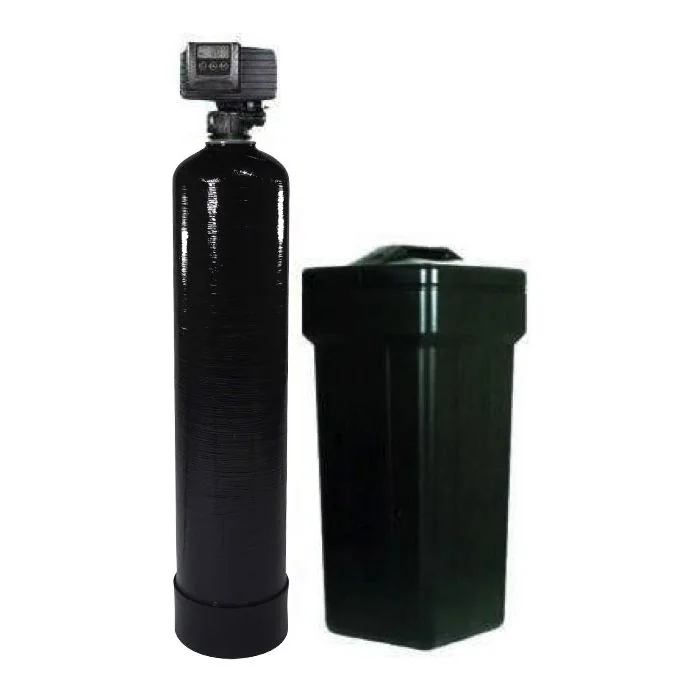
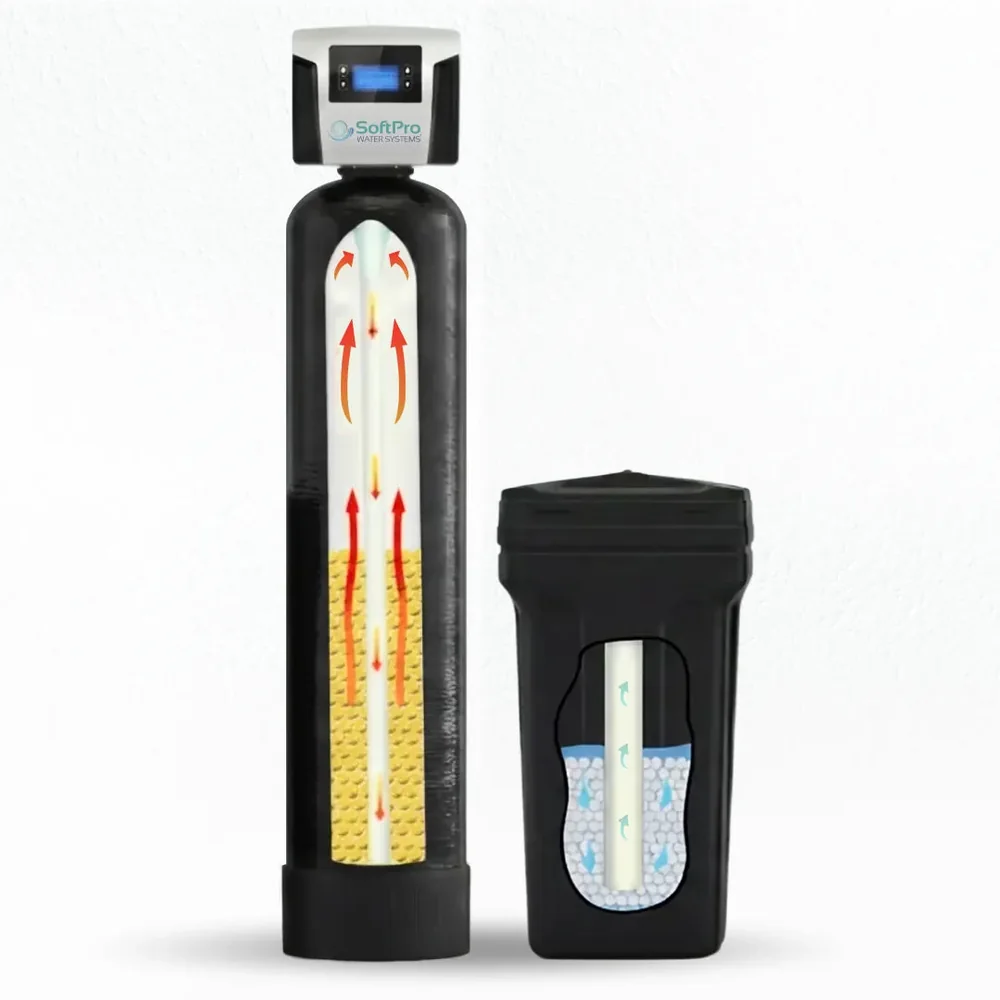
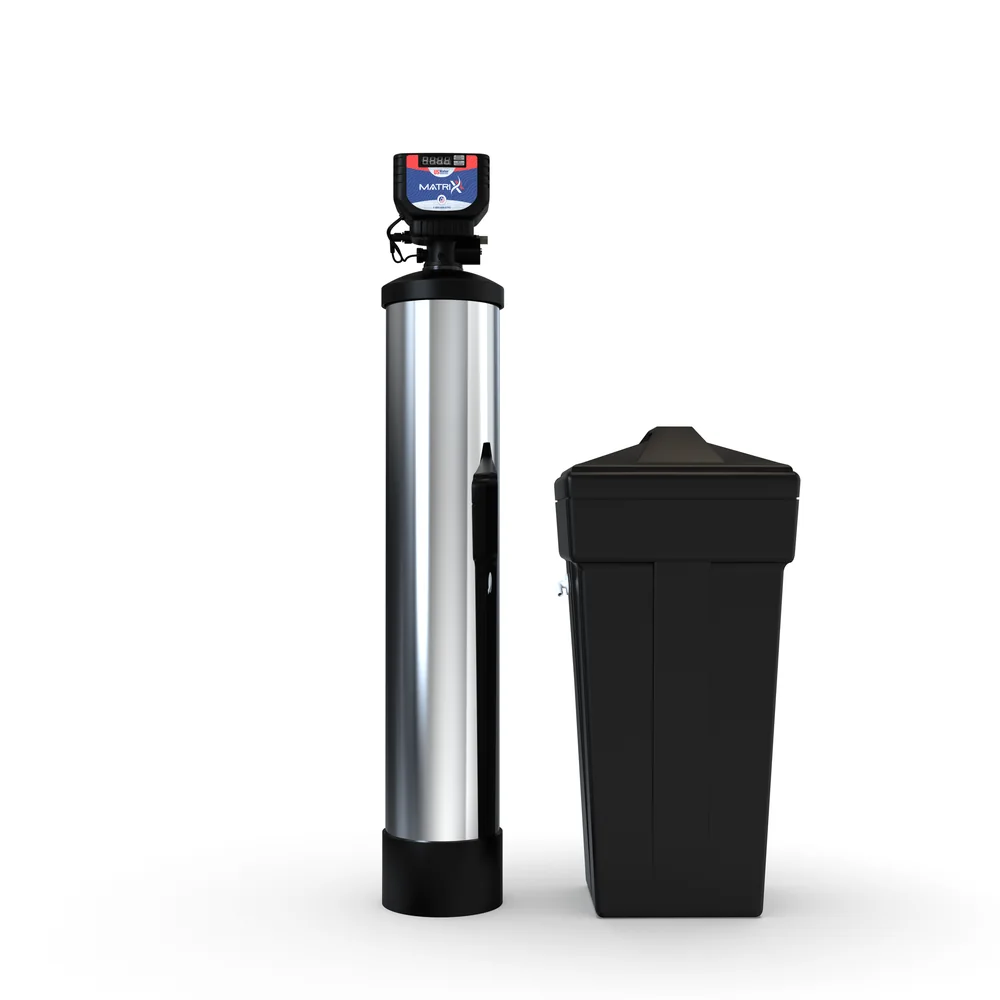
For the systems in our softener ranking, the checked prices on November 9, 2026 were $876 for the Fleck 5600SXT, $1,367 for the SoftPro Elite, $1,466.95 for the Matrixx and $1,890 for the SpringWell SS1, each at its 1-3 bathroom size. Add Angi's labor range and a Fleck lands at roughly $1,026 to $1,876 installed, a SpringWell at $2,040 to $2,890.
What makes the bill go up
- No drain nearby: a salt-based softener flushes brine during each regeneration. If the closest floor drain or standpipe is across the basement, the plumber runs a new line.
- No outlet: metered valves need power. An electrician adds a circuit if there is no outlet within reach.
- A tight spot. Resin tanks run about 9" x 48" for a 32,000-grain model, plus a brine tank. Squeezing that into a finished utility closet takes longer than a garage wall.
- Old or mixed pipes. Galvanized or undersized pipes may need replacing near the main line.
- A bigger house. Angi lists 32,000-grain units at $400 to $1,000 for materials, 64,000-grain units at $800 to $1,500. Use our size calculator before you pay for capacity you will not use.
- Permits: some towns require a plumbing permit; Angi notes the fees vary by municipality.
CarefulCheck local rules before you buy a salt-based softener. In the Santa Clarita Valley, Los Angeles County Sanitation Districts prohibit automatic, self-regenerating salt-based softeners. A salt-free conditioner is the usual way around that.
Can you install it yourself?
Many homeowners do. The brands in our data sell their systems direct, with installation guides and bypass valves. If you have cut and joined copper or PEX before and there is a drain and an outlet close to the main line, a softener is a weekend job. If you have never shut off your main water valve, call a plumber: a leaking joint on the main line is the expensive kind of leak.
- Get your hardness (and iron, on a well) from a test or your city report.
- Size the softener with the calculator.
- Pick a spot near the main line, after the pressure tank on a well and before the water heater, with a drain and an outlet.
- Leave the outside spigots on hard water if you can: there is no point softening the lawn.
- Install with a bypass valve so you can service the softener without shutting off the house.
- Program the hardness and household size into the valve; the defaults are rarely right.
The yearly running cost
After installation, a salt-based softener costs you salt, a little water and a little power. US Water Systems states 3 lb of salt per regeneration for the Matrixx on its efficient setting; at one regeneration a week, that is about 156 lb a year, or four 40 lb bags. At Angi's $5 to $10 per bag, roughly $20 to $40 a year. A softener on a less efficient setting can use several times more.
A salt-free conditioner has no salt cost, but its media wears out: SoftPro rates the Fortress media at about 5 years for the Pro model and Aquasana rates its conditioner at 10 years.
TipPotassium chloride replaces sodium in the softened water, which some people prefer for diet reasons, but Angi puts it at $50 to $70 a bag, around seven times the price of salt.
Systems mentioned in this guide
Frequently asked questions
How much does it cost to install a water softener?
About $1,500 on average in 2026, per Angi, with most homeowners paying $200 to $6,000. Labor alone is $150 to $1,000. A new drain line adds $300 to $800, per HomeGuide.
How much does a plumber charge to install a water softener?
Angi lists $150 to $1,000 of labor for a typical install. Expect the high end if the plumber needs to run a drain, reroute pipes or work in a tight space.
Is it worth paying for professional installation?
It depends on your plumbing skills. The job is cutting into the main line and adding a bypass, a drain and an outlet. If any of that is new to you, the labor costs less than a flood.
What is the cheapest water softener to install?
In our data, the SoftPro Fortress salt-free conditioner ($529) needs no drain or outlet, which also keeps labor low. Among salt-based softeners, the Fleck 5600SXT was the cheapest at $876 on November 9, 2026.
Sources
Angi, water softener installation cost (updated Oct 29, 2026) · HomeGuide, water filtration system cost (Sept 17, 2025) · Los Angeles County Sanitation Districts, softener prohibition in the Santa Clarita Valley. Read on November 9, 2026.